
The shawls of Kashmir
Sozni: a story told in small stitches
Look past the outline of a motif and towards the stitches that give it form. Sozni is a way into the needlework of Kashmir: decoration worked on a fabric, with its own questions about thread, design and the person making it.
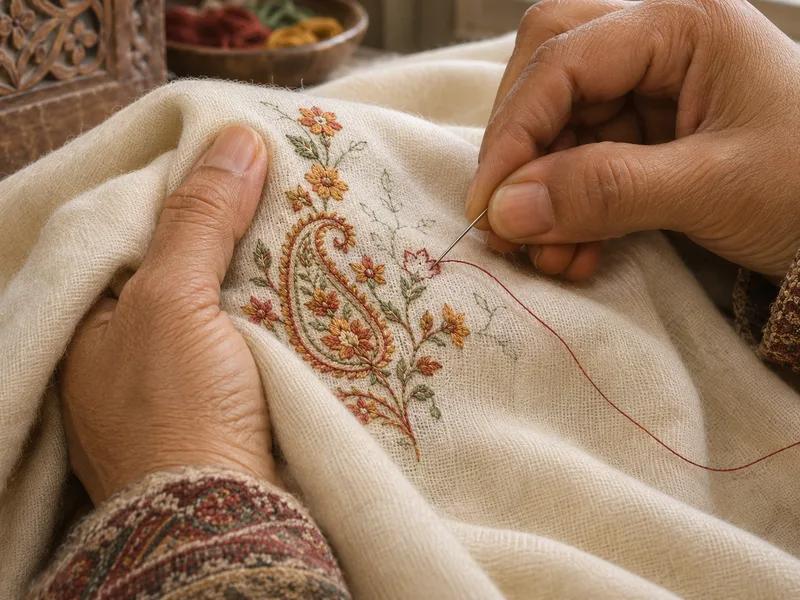
AI illustration of Sozni needlework in progress.
What the needle adds to the cloth
CBSE’s Kashmiri Embroidery manual describes Sozni as fine needlework used to decorate pashmina shawls, and also notes other fabrics such as cotton and silk. It identifies fine needle-and-thread work and satin stitch in its description of the craft.
This helps separate two questions when you read a shawl label: what is the base fabric, and what has been worked onto it? Both matter. An embroidery description can explain the decoration while leaving the composition of the cloth unanswered.
Further reading: CBSE: Kashmiri Embroidery, Class VIII, Unit 3 (PDF, Unit 3)From a drawn design to needlework
The manual outlines a process that includes preparing a design, transferring it to fabric, working the embroidery and finishing the shawl. Its account brings attention to preparation as well as stitching: the finished motif has a making process behind it.
When looking at a piece, ask about the design as well as the stitches. Who chose the motif? How was it prepared for the embroiderer? Following those questions gives you a fuller account than the finished photograph alone.
Further reading: CBSE: Kashmiri Embroidery, Class VIII, Unit 3 (PDF, Unit 3)Look closely, then ask about what you see
Choose a small area of a shawl to discuss rather than relying only on its overall appearance. Ask how that motif was worked, what thread was used and how the seller describes the extent of the handwork. Request clear close-up images when browsing remotely.
The answers can make a comparison more informative, but an attractive close-up cannot authenticate a piece on its own. Keep the maker’s account, the seller’s description and any independent evidence distinct. You should be able to tell who supplied each claim.
Bring material, decoration and care together
Before buying, ask for information about the complete piece, including its embroidered areas. Keep the written care advice rather than assuming one cleaning method suits every shawl.
- What is the base fabric’s composition?
- What thread and embroidery technique are described?
- Who did the needlework, and what handwork claims are supported?
- What item-specific care and return instructions are supplied?
Common questions
Are Sozni and Kani the same process?
This guide uses Sozni for needle embroidery on fabric. Our Kani guide focuses on pattern-making through weaving. Follow both descriptions when comparing a piece.
Does Sozni automatically mean the fabric is pashmina?
No. The CBSE manual also describes Sozni on other fabrics. Ask for the base material separately from the embroidery description.
Continue exploring
Back to the Shawls hubKashmirSoul’s shawls guides are editorial introductions. We do not currently sell or authenticate shawls.